
The Five Stages of AI Adoption — and Why Security Comes First
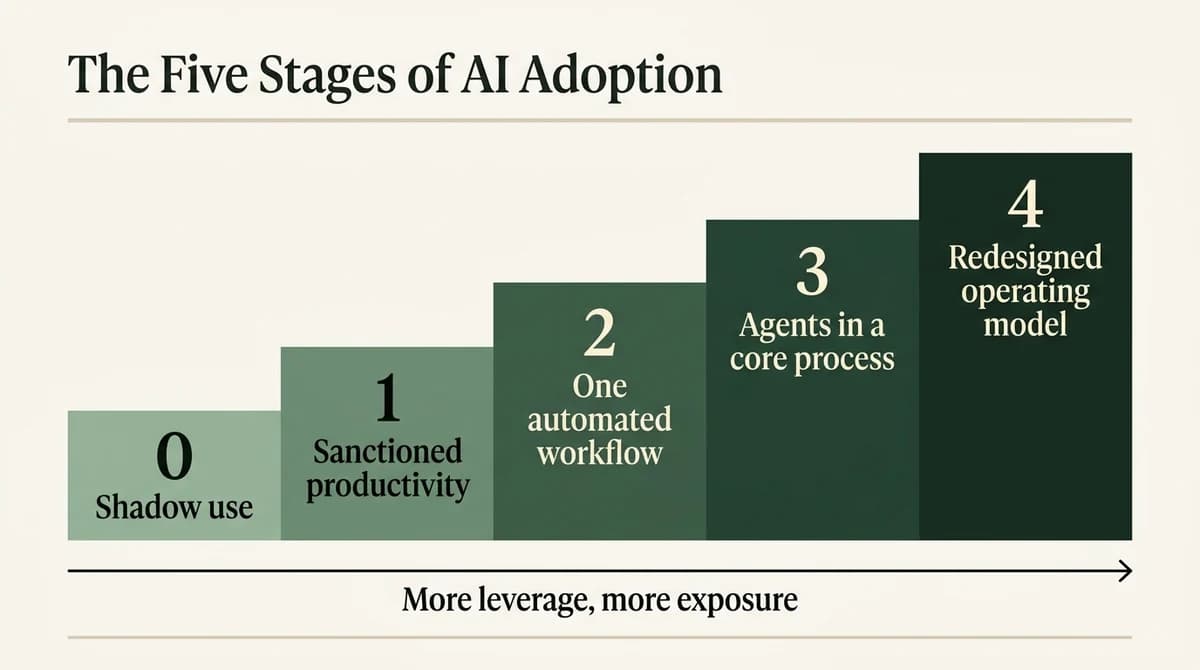
Ask a leadership team where they are on AI and the answer is usually "well advanced". Ask which process runs differently than it did a year ago, and the room goes quiet.
Over the past year I have seen companies at both ends of that gap: one that moved too little and called it progress, and one that moved fast and paid for it. Both stories make more sense once you place them on a ladder.
The ladder (link to section)
Each stage has a different bottleneck. Each one also gives the AI more access than the one before, which is the part most adoption plans leave out.
Stage 0 — Shadow use. People use personal accounts for work. Nobody knows which data is going where. Ask: do you know which tools your team used this week?
Stage 1 — Sanctioned productivity. Company licenses, a usage policy, maybe an internal chatbot. The gains are individual. Ask: what did the saved hours get redeployed to?
Stage 2 — One automated workflow. A single repetitive process runs end to end with AI doing the work. Ask: who owns it, and who reviews its output?
Stage 3 — Agents inside a core process. An agent reads your systems and acts in them: mail, CRM, orders, finance. Ask: what can it touch, and what happens if someone else is steering it?
Stage 4 — A redesigned operating model. Roles, headcount plans and contractor contracts are rebuilt around the new cost of work. Ask: did the org chart change? Almost nobody is here yet.
Story one: the chatbot that was an experiment (link to section)
Some months ago, a large consumer goods group built an internal AI tool: a chatbot for employees, on company data, with a proper launch.
The results were hard to pin down. Some people used it, some liked it, and nobody could point to a process that had become faster or cheaper, or to a decision that had been made better. It was an experiment presented as a programme.
That is stage 1, and there is nothing wrong with stage 1. The problem is mistaking it for stage 3. Budgets, board updates and expectations were all being set against a position the company had not reached. A tool is not a changed process. Until one process with an owner and a number attached runs differently, you are still at the start of the ladder.
Story two: the agent that had the keys (link to section)
More recently, a small company went the other way. It set up an agent and connected it directly to its working tools, including email.
This is what small companies can do and large ones cannot: skip from stage 0 to stage 3 in a few weeks. The agent was useful almost immediately.
It was also wide open. An agent that reads an inbox is reading text written by strangers, and it was running with an employee's full access and no isolation between what it read and what it could do. Anyone who could steer the agent could do anything that employee could do.
The result was a security incident: compromised emails went out to customers. It was contained quickly. But the damage to the effort was larger than the damage from the incident. Trust in the project dropped, inside the company and with the customers who received those emails, and work that had been moving fast stopped.
What the two stories have in common (link to section)
One company climbed too slowly and overestimated its position. The other climbed fast and skipped the foundations. Neither had a problem with the technology.
The lesson I take from the second story is the one I would put first for anyone moving past stage 2: design the isolation before you grant the access. In practice:
- Give the agent its own identity. It should have its own account and its own narrow permissions, never a copy of an employee's.
- Start read-only. Add the ability to act one capability at a time, and only where you have seen it work.
- Keep a human on anything that leaves the building. An agent can draft the email. A person sends it.
- Treat everything it reads from outside as untrusted. Email, web pages and attachments are input from strangers, and an agent can be talked into things.
None of this is exotic. It is the same separation of duties you already apply to a new hire with access to the bank account.
Where this leaves you (link to section)
If you run an established company: you are probably at stage 1 or 2, whatever the last update said. Pick one process, give it an owner and a number, and get it to stage 2 properly before funding anything larger.
If you run a small company: you can reach stage 3 this quarter, and you should try. But the speed is exactly the risk. Spend the first week on what the agent is allowed to touch, and the second on what it does.
Every stage up the ladder is more leverage and more exposure. Climb it in that order: security first, then speed.
Which stage are you really at?